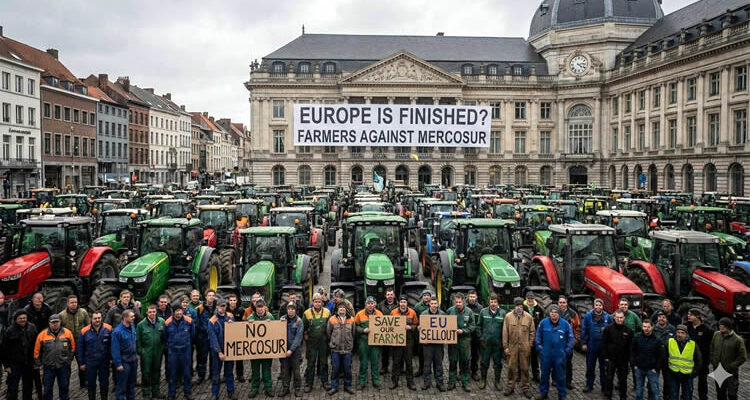


Farmers from across Europe recently gathered in Brussels near EU headquarters to protest the proposed trade agreement between the European Union and Mercosur countries.
Their message was simple: the deal threatens their livelihoods and the long-term stability of European agriculture.
This protest was not symbolic; it reflected years of frustration over rising costs, strict regulations, and shrinking margins.
European farmers argue that the Mercosur agreement allows imports produced under looser environmental and labor standards.
This creates an uneven playing field that local producers cannot realistically compete with.
While EU policymakers promote the deal as a boost to trade and global cooperation, farmers see it as a direct economic risk.
Beef, poultry, sugar, and grain imports from South America could undercut European prices almost immediately.
Many family-owned farms already operate at the edge of profitability.
An influx of cheaper imports could push thousands out of business.
Supporters of the deal claim consumers will benefit from lower prices.
However, lower prices often come at the cost of domestic production capacity.
Once farms disappear, rebuilding food security is not fast or cheap.
Europe has learned before that dependency on external suppliers can become a strategic weakness.
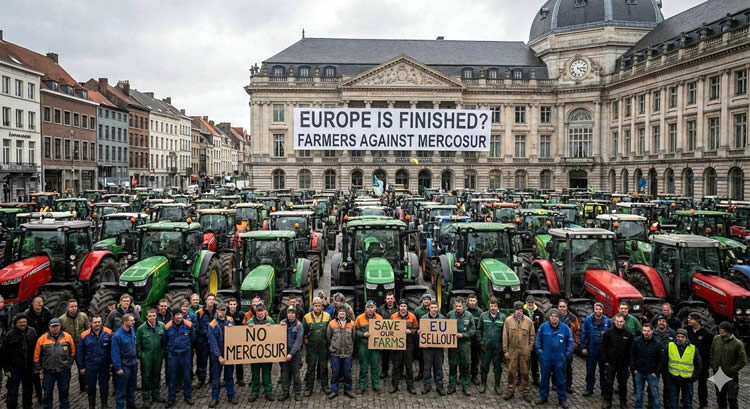
The protests in Brussels also highlight a deeper issue within the EU system.
Decisions affecting millions of rural workers are often made far from the fields they impact.
Farmers feel excluded from negotiations that directly determine their future.
This gap between policymakers and producers continues to widen.
The Mercosur deal may increase trade volume, but it also raises questions about sustainability and fairness.
If standards are enforced unevenly, regulation becomes punishment rather than protection.
Economic efficiency alone cannot replace long-term resilience.
Agriculture is not just another industry; it is the foundation of food supply and rural economies.
Whether Europe is truly “finished” is debatable.
What is clear is that ignoring these warnings could have lasting consequences.
The protests are not about ideology, but survival.
If leaders fail to address these concerns now, the damage may become irreversible.