


When Canadian Climate Goals Collide With Energy Reality
Canada — one of the world’s largest natural gas producers — is importing liquefied natural gas (LNG) shipped roughly 25,000 km from Australia to the East Coast.
At first glance, this sounds absurd. But behind this long journey is a deeper story about government policy, green agendas, infrastructure gaps, corporate interests, and climate contradictions.
This article explains the hard truth — in simple terms.
The Situation in Plain English
Canada produces a lot of natural gas, mostly in Western provinces. But much of Eastern Canada lacks direct pipeline access to that supply.
Instead of expanding domestic pipelines, Canada is temporarily importing LNG delivered by ocean tankers from overseas suppliers like Australia.
In simple terms:
Canada has food in the fridge.
But instead of walking it to the table, it orders takeout from another continent.
Are Government Decisions Aligned With Public Needs?
This is where things get uncomfortable.
Government energy decisions are often influenced by three forces:
-
Environmental policy goals
-
Economic and corporate interests
-
Political optics
In theory, public policy should prioritize:
-
Affordable energy
-
Energy security
-
Environmental responsibility
-
National economic strength
In reality, political decision-making is often fragmented.
Some infrastructure projects that would move Canadian gas internally have faced regulatory delays, legal challenges, or political opposition. At the same time, importing LNG becomes a short-term solution that avoids domestic pipeline battles.
Does this always reflect citizens’ needs?
Not necessarily.
Sometimes it reflects:
-
Short-term political risk avoidance
-
Pressure from activist groups
-
International climate positioning
-
Corporate trading opportunities
That doesn’t automatically mean corruption. But it does mean decisions may benefit specific industries more directly than average households.
The Green Agenda Question
Canada presents itself as a climate leader under international frameworks like the United Nations climate agreements and supports global decarbonization efforts under the Paris Agreement.
The federal government under Justin Trudeau has promoted carbon pricing and emissions reduction targets as central pillars of policy.
But here is the contradiction:
LNG shipped 25,000 km by ocean tanker burns fuel during:
-
Liquefaction
-
Transport
-
Regasification
-
Distribution
Ocean tankers run on heavy marine fuels or LNG itself, producing emissions.
So while importing LNG may comply with trade rules, it increases:
-
Maritime fuel use
-
Global shipping emissions
-
Lifecycle carbon footprint
If environmental leadership is the goal, long-haul fossil fuel imports are difficult to defend from a climate-efficiency standpoint.
Pollution and Ocean Tankers
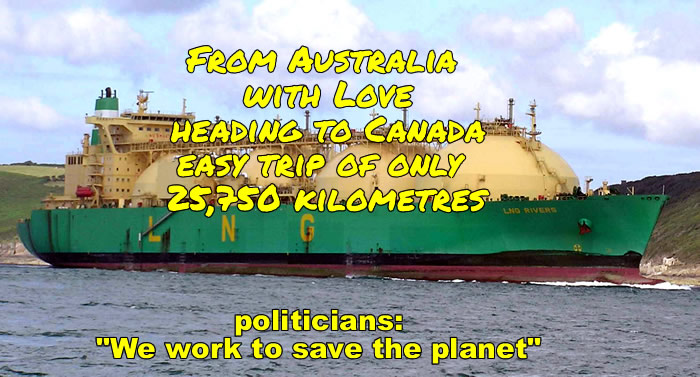
Large LNG carriers are engineering marvels — but they are not zero-impact.
Environmental concerns include:
-
Greenhouse gas emissions from marine engines
-
Methane slip (unburned methane leakage)
-
Risk of marine fuel spills
-
Increased ocean traffic
Shipping remains one of the harder sectors to decarbonize globally.
So importing LNG across oceans while advocating domestic emission reductions creates policy tension.
Who Benefits?
In global LNG trade:
-
Producers benefit
-
Shipping companies benefit
-
Commodity traders benefit
-
Terminal operators benefit
Short-term market conditions sometimes make it financially viable to reroute LNG cargoes to unexpected destinations.
When infrastructure gaps exist domestically, import contracts can become profitable opportunities for global energy companies.
That does not automatically imply corruption.
But it does raise legitimate questions about alignment between national resource wealth and domestic consumption strategy.
Energy Security vs Climate Signaling
Canada faces a strategic balancing act:
-
Meeting climate targets
-
Maintaining reliable energy access
-
Avoiding domestic infrastructure conflicts
-
Supporting economic growth
Importing LNG may solve an immediate supply or market issue.
But from a systems perspective, it highlights:
-
Infrastructure planning gaps
-
Regional energy imbalances
-
Policy inconsistency
A country rich in natural gas importing long-distance LNG sends mixed signals about energy coherence.
The Hard Truth
This situation is not simply about “good” or “bad.”
It is about policy alignment.
When:
-
Domestic resources exist
-
Infrastructure is incomplete
-
Climate leadership is emphasized
-
Fossil fuel imports travel 25,000 km
There is a disconnect between environmental messaging and logistical reality.
Energy transitions require long-term planning. Without integrated infrastructure strategy, countries can find themselves making decisions that appear contradictory — even if they are legally and economically explainable.