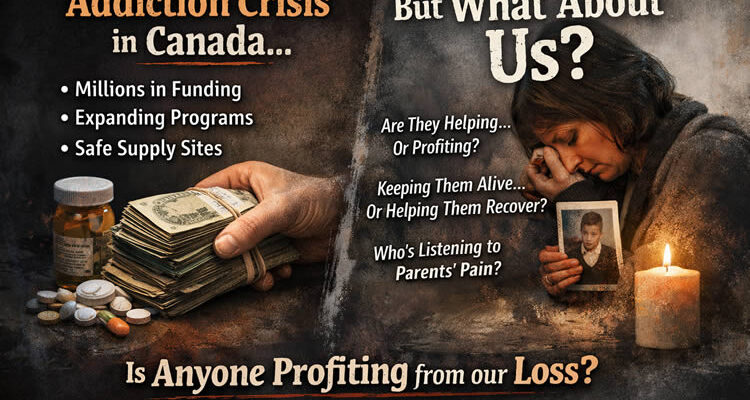


A closer look at the growing concern that addiction policies may be managing the crisis — not ending it
Canada’s opioid crisis is often measured in statistics — overdose rates, funding levels, and program expansions. But for many families, those numbers don’t tell the full story.
Behind them are parents, siblings, and loved ones living through something far more personal.
And increasingly, some are asking a difficult question:
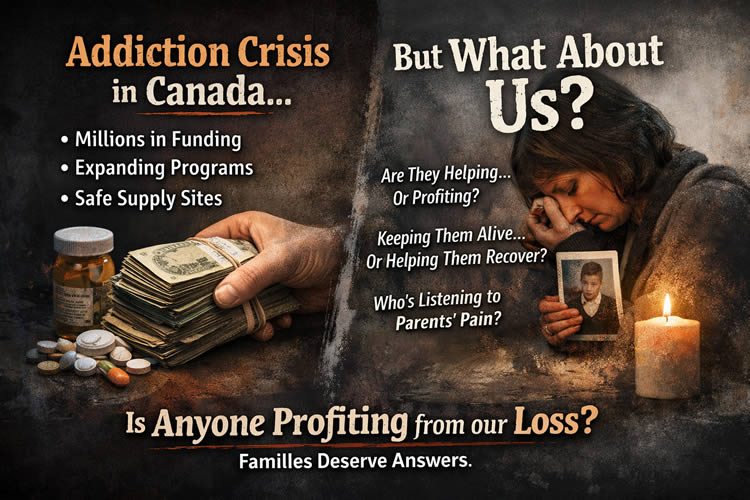
Is the system truly helping people recover — or has it become structured around managing addiction instead?
The Gap Between Policy and Reality
Safe supply programs were introduced with a clear purpose: reduce overdose deaths by providing regulated alternatives to dangerous street drugs.
On paper, the goal is straightforward — keep people alive.
But for many families, survival alone is not enough.
They describe watching loved ones remain stuck in cycles of addiction, with no clear path toward recovery. While programs expand and funding grows, the outcomes they hope for — stability, independence, healing — can still feel distant.
“We’re told this is helping, but our children aren’t getting better.”
A System That Keeps Growing
One of the most sensitive concerns being raised is whether an entire system has formed around the crisis itself.
This includes programs, organizations, and ongoing public funding dedicated to addressing addiction.
To be clear — this does not mean individuals working within these systems intend harm. Many are deeply committed to helping.
But the structure raises an important question:
When a crisis sustains funding and growth, how do we ensure the goal remains ending the crisis — not maintaining it?
For some families, this creates a painful perception that the system continues to expand, while real recovery remains out of reach.
Why Some Voices Feel Unheard
Another layer of frustration is the sense that these concerns are not always openly acknowledged.
Some parents say that when they question current approaches, they feel dismissed or overlooked. Whether that perception is entirely accurate or not, it contributes to a broader feeling:
That certain conversations are uncomfortable — and therefore avoided.
This can create distance between policymakers and the people most directly affected.
And when trust breaks down, even well-intentioned policies can feel disconnected from reality.
Two Perspectives, One Crisis
There is also another side that cannot be ignored.
Healthcare professionals and policymakers often argue that without harm reduction strategies like safe supply, the situation could be far worse. Preventing overdose deaths is seen as the immediate priority.
From this perspective:
- Stability comes before recovery
- Keeping someone alive creates the chance for future change
- Removing support systems could increase harm
This is where the divide becomes clear:
- Families often want urgency toward recovery
- Systems often prioritize immediate survival
” …In January alone, 150 people died from toxic drugs in B.C — that’s nearly five people every single day. Five people who didn’t get recovery. Five people who didn’t get their lives back. Five people whose addictions were managed instead of ended. Five families grieving. … ” read more =>>
“… The Liberals spent $4.5 MILLION to fund vending machines that literally dispensed opioids to those suffering with addiction.
Health Canada then handed this organization $4.5 million to build opioid vending machines in multiple cities through the Substance Use and Addictions Program…” . more here=>>
The Question That Won’t Go Away
At the center of this debate is a question that continues to surface:
Are current approaches helping people move beyond addiction — or primarily helping them survive within it?
It’s not an easy question.
And it doesn’t have a simple answer.
But avoiding it doesn’t make it disappear.
What Families Are Really Asking For
Most families are not looking to assign blame.
They are asking for:
- Clear pathways to recovery
- Accountability in how success is measured
- Honest conversations about what is — and isn’t — working
- A system that reflects both compassion and long-term outcomes
Above all, they want to feel that their voices matter.
“We don’t just want them alive. We want them to have a life.”
Final Thoughts
Canada’s opioid crisis is complex, and no single approach will solve it overnight.
But one thing is clear:
any meaningful response must include the voices of those living through it.
Families are not statistics.
They are part of the solution.
And their questions deserve to be heard — openly, honestly, and without dismissal.