


When Canada’s Political Rules Waste Food and Hurt Families
Canada recently witnessed an astonishing reality: millions of litres of perfectly good milk were poured down the drain — not because it was spoiled or unsafe, but because political rules mandate waste. Yes, you read that correctly. Edible milk was destroyed on purpose as a consequence of how our agricultural policies are structured.
This is not just a quirky statistic — it is a glaring example of how political decisions can be misaligned with public needs, economic logic, and environmental responsibility.
Let’s break it down clearly, in plain language.
What Actually Happened
Under Canada’s supply management system — a regulatory framework controlled by federal politicians and provincial boards — dairy production is tightly controlled through quotas and price structures.
When farmers produce more milk than their political quota allows — even by a small margin — they are not permitted to sell it commercially. The result? Milk is sometimes intentionally dumped or destroyed, even if it is perfectly fine for consumption.
In recent months in Ontario alone, milk worth millions of dollars at grocery store value was thrown out simply because it couldn’t be marketed. That’s milk wasted while grocery prices stay high and food bank demand increases.
This isn’t an accident. It’s the direct outcome of political rules.
Why This Is a Political Outcome
This isn’t about market forces or natural shortages. The root cause is policy design:
✔️ Politicians created and maintain supply management
✔️ Supply management restricts production and controls pricing
✔️ Excess supply cannot legally enter the market
✔️ Farmers must dispose of milk they cannot sell
In other words:
The waste isn’t organic — it’s engineered.
And it raises an uncomfortable question:
Why do political choices that protect certain economic interests result in wasted food and higher prices for everyone else?
Does This Policy Reflect Citizens’ Needs?
If the purpose of public policy is to support the wellbeing of communities, then a system that:
-
Disposes of food that could feed people,
-
Keeps grocery prices elevated,
-
And creates artificial scarcity,
… clearly misses the mark.
This system benefits specific groups:
-
Quota owners
-
Regulatory boards
-
Certain agricultural stakeholders
But it does not benefit:
-
Consumers struggling with high food costs
-
Families facing food insecurity
-
People watching good food go to waste
This is policy shaped by political interests — not public demand.
Environmental Costs Too
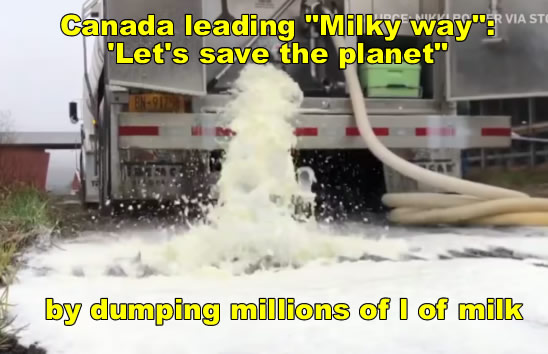
Pouring millions of litres of fresh milk down the drain isn’t just financially wasteful — it’s environmentally wasteful.
Consider all the inputs that go into milk production:
-
Water
-
Feed for cows
-
Land use
-
Energy
-
Labor
When milk is purposely dumped, all of those resources are wasted too. That increases environmental impact — something that contradicts broader goals of sustainability and climate responsibility.
So the waste isn’t only economic — it’s ecological.
“Protecting Farmers” or Protecting Rents?
Supporters of supply management often argue it:
-
Protects farmers’ incomes
-
Stabilizes rural economies
-
Prevents volatile price swings
But when protections lead to waste and higher consumer prices, it begs a serious policy question:
Are we protecting farmers — or protecting a political mechanism that creates economic rents for a few at the expense of many?
In economics, a “rent” refers to profit earned because of privilege or restriction — not because of competitive efficiency. Supply management creates such rents for quota holders — and others pay the cost.
Alternatives Exist — But Politicians Don’t Act
Experts have pointed to ways the system could be modernized:
-
Flexible quota responses tied to actual demand
-
Temporary outlets for surplus milk
-
Expanded processing options
-
Legal frameworks for small-scale sales
None of these ideas require dismantling dairy production. They simply require political will to update outdated rules.
But political will is exactly what’s missing.
The Hard Truth
This isn’t a story about scarce food.
It’s a story about political design — and political inertia.
When:
-
Food is wasted on purpose,
-
Prices stay artificially high,
-
And citizens shoulder the consequences,
…it reveals a disconnect between political policy and the real needs of people.
The problem isn’t milk —
it’s the political choices that govern how milk is produced, priced, and distributed.
Those choices deserve scrutiny.